
What’s your vision?
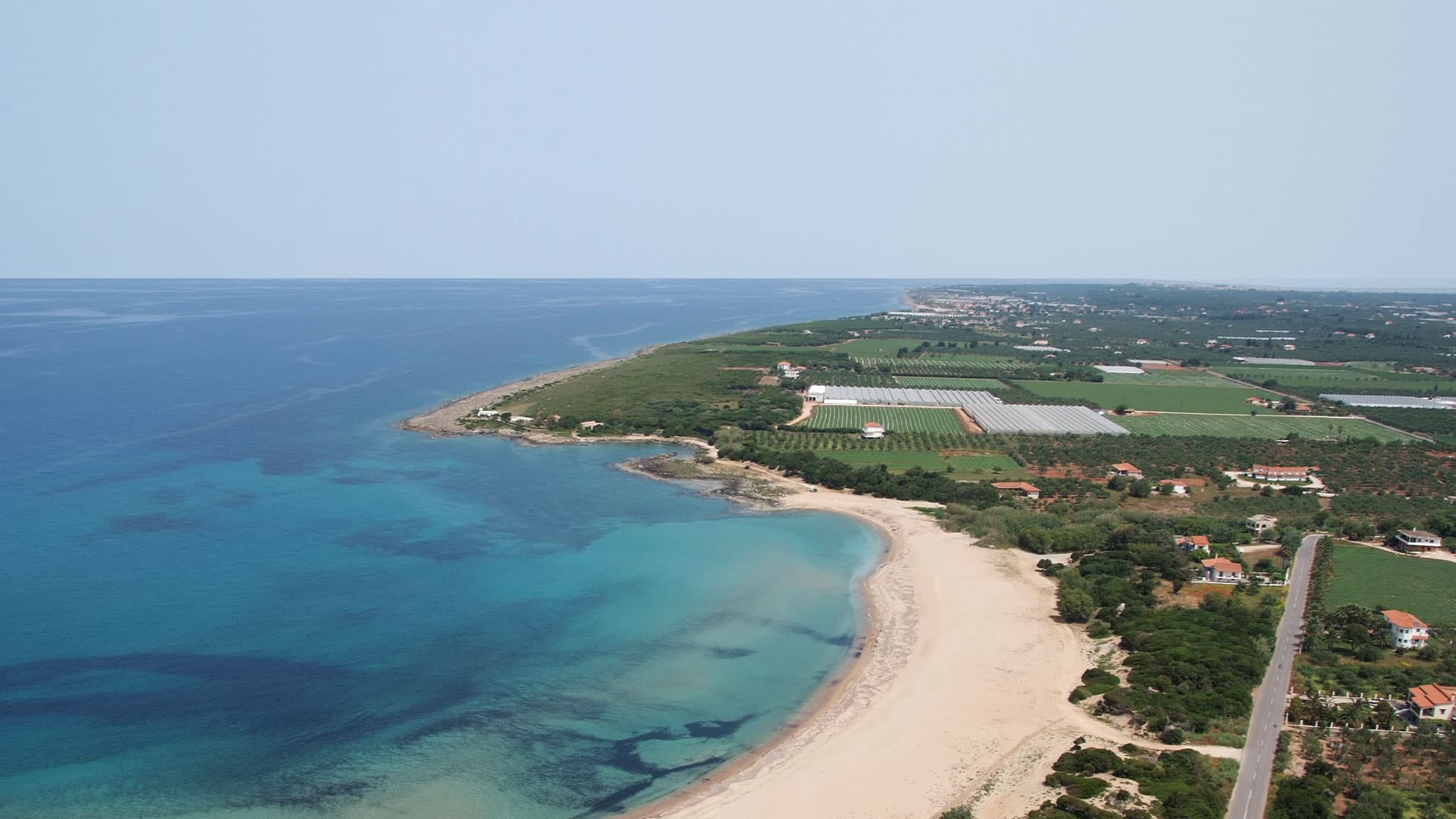
20,000 m² of beachfront on Greece’s last undeveloped coast. What would you build?
The surf economy
A single wave can be worth $24 million a year. A World Surfing Reserve designation can triple property values. A viral big-wave clip can turn a three-month tourist season into an eleven-month economy. This is what happens when surf meets coastline.
What a wave is worth
In 2013, Save The Waves Coalition began publishing economic valuations of individual surf breaks — a discipline they call “surfonomics.” The results changed how governments, developers, and conservationists think about coastline. Waves are not scenery. They are economic infrastructure.
Across eight major breaks studied, the combined annual economic value exceeds $250 million. The methodology counts direct spending (travel, accommodation, food, equipment), indirect effects (jobs, tax revenue, business creation), and consumer surplus — what visitors would have been willing to pay above what they actually spent.
Annual economic contribution from surfing across 31 breaks. 783,000 surf visits per year. Each foot of sea-level rise costs $12.8M in lost value.
Save The Waves Coalition, 2024Net economic value of a single big-wave break. 421,431 visitors per year. Average consumer surplus: $57 per trip.
Save The Waves SurfonomicsTotal impact from one WSL Championship Tour event. 120,000 spectators. €13.3M spent on goods and services. €6M in tax revenue.
Portuguese Tourism Board, 2024Annual value of a single rivermouth wave. When dredging destroyed the break in 2005, the village's economy collapsed overnight. The wave eventually returned — the economy followed.
Save The Waves / Academic studiesBefore and after
Every surf town transformation looks different on the surface. A world record wave. A reserve designation. A WSL event. An Instagram post. Underneath, the economics follow the same arc.
Ericeira, Portugal
World Surfing Reserve (2011)Europe's first World Surfing Reserve. 37% of residents now cite surfing as a decisive factor for living there. Twenty surf schools where there were three. The economy has been completely 'touristized' around the wave.
Nazaré, Portugal
Big wave discovery (2011)Garrett McNamara's 78-foot wave turned a struggling fishing town into a global destination. The Nazaré Challenge generates €3M per event. 69.5% of visitors are international. The lighthouse became one of Portugal's most photographed landmarks.
Hossegor, France
WSL Championship Tour hostHome to Quiksilver, Rip Curl, and Billabong's European headquarters. $60M annual revenue from surf tourism. Population of 4,000 swells to 30,000–40,000 in summer. Property prices rival the Côte d'Azur.
Taghazout, Morocco
Surf camp boom + government investmentFrom a handful of surf camps to a Tripadvisor Travellers' Choice destination. Morocco now welcomes ~1 million surf visitors annually. The government committed €550–750M to the Taghazout Bay mega-project.
Siargao, Philippines
Social media + airport upgradeCloud 9 went from a surfer's secret to the Philippines' most Instagrammed island. International arrivals grew from 13,600 to 54,000. Accommodation options increased 300%. Beachfront land values: 10–30× increase.
Byron Bay, Australia
Surf culture + lifestyle migrationTourism contributes 22.5% of the local economy — AU$1.1 billion in sales. One in six jobs depends on it. Beachfront properties at Wategos Beach sell for AU$10–20M+. The original surf town is now a luxury market.
How it happens
The trigger varies. The trajectory doesn't.
Discovery
Surfers find the wave. Word spreads through lineups, not brochures. A handful of camps or guesthouses open. Locals are bemused.
Catalyst
A WSL event. A world record. A viral clip. A reserve designation. The outside world notices. Media value runs into millions.
Infrastructure
Surf schools, cafes, yoga studios, coworking spaces, boutique hotels. A micro-economy forms around the break. Airport adds routes.
Transformation
Property values climb 3–10× over a decade. The economy runs year-round. The fishing village is now a destination. Irreversible.
Ericeira is at stage four. Nazaré hit stage two in 2011 and reached four by 2020. Taghazout is between three and four. Messinia has the waves, the infrastructure catalyst, and the global attention. It sits at stage one.
The ideal tourist
Surf tourists are not backpackers on a budget. The data consistently shows a high-education, high-income, long-stay demographic — exactly the visitor profile that coastal towns want but rarely attract outside peak summer.
They travel in small groups or solo, fitting boutique hospitality rather than mass-market resorts. They eat at local restaurants, not hotel buffets. They stay 11–14 days on average — twice the length of a typical European city break. And 32% of recent bookings were “work + surf” stays of 14 days or longer: remote workers choosing their coast by its waves.
The wellness overlay amplifies this. Europe saw a 50% increase in surf + wellness retreat packages between 2021 and 2024. Yoga, meditation, and clean eating layered onto a surf trip raise the average daily spend and attract a demographic that indexes heavily on accommodation quality.
The season flip
Greece has one of the most seasonally concentrated tourism economies in Europe. Seventy to seventy-five percent of all arrivals happen between May and October. For five months of the year, coastal towns go quiet. Hotels close. Restaurants shutter. Workers leave. Surf reverses this.
The Nazaré proof
Before 2011, Nazaré operated for three months. Restaurants closed in September. Hotels shuttered in October. The fishing economy couldn't sustain the town alone. Today, surf events alone generate €23 million, and the economy runs eleven months of the year. One wave did that.
The big-wave season (October–March) created a second peak that overlaps perfectly with what was previously dead time.
The Greece parallel
Greece's kitesurf industry proved the model. Paros and Naxos built €15–30 million niche economies around summer Meltemi winds. They extended the season by 2–4 weeks on each end. A single kitesurf school with 10–15 instructors generates €200,000–500,000 in seasonal revenue.
Surf does the same thing — but in winter, filling the opposite gap.
What this means for Messinia
Western Messinia isn't Ericeira. It doesn't need to be. The surf won't be world-class and the waves won't break triple overhead. But the economic pattern doesn't require perfection — it requires timing, access, and an empty coast in the right place at the right moment.
Counter-seasonal waves
Western Peloponnese picks up Ionian swells November through March — exactly when Greek tourism is dead. The surf season fills the gap, not competes with it.
Warmer water
Winter water temperatures of 16–18°C. Portugal's Atlantic coast is 12–14°C. A 3/2mm wetsuit here versus a 5/4mm there. Comfort matters for the growing casual-surfer market.
Empty lineups
Ericeira is packed. Peniche is crowded. Taghazout is getting there. The western Peloponnese has two-kilometre beach breaks with nobody on them. For surfers fleeing Atlantic crowds, that's the pitch.
The infrastructure is arriving
Kalamata Airport: 339,000 passengers in 2025, nine new international routes for 2026, terminal expansion committed. The gateway is opening — the coast just needs a reason to visit in winter.
Lifestyle destination, not just a surf trip
Ancient Messene. Thermal springs at Kaiafas. The Menalon Trail. Costa Navarino's year-round restaurants. Messenian olive oil and wine. Surfing anchors a winter stay — Greek culture fills the rest.
The Nolan catalyst
The Odyssey releases July 2026. Messinia is already in the global conversation. First-time visitors arriving for the film's buzz will discover a coast that works in winter too.
The economics are simple
A $68 billion global market is growing at 6% a year. The demographic is affluent, educated, and travels longer than average. The infrastructure multiplier is well-documented: surf schools, cafes, coworking spaces, boutique hotels, wellness retreats — each one creating jobs and extending the season.
Every coast that has embraced this has transformed. Ericeira. Nazaré. Taghazout. Siargao. The pattern is the same everywhere. A fishing village with a wave becomes a year-round economy with a story.
Messinia has a two-kilometre beach break, winter waves, warm water, an expanding airport, a billion-euro resort next door, anda Christopher Nolan film about to put it on the map. The convergence is unusual. The window is finite.
The towns that moved early own the story. The ones that waited become footnotes.
Related research
Surf Mecca
Why the western Peloponnese is positioned to become Greece's first surf destination
The Nolan Effect
What happens to property values when a blockbuster film puts a coast on the map
Costa Navarino Effect
How a single resort created a ripple effect across 60 km of coastline
Wellness Tourism
The convergence of surf, yoga, and clean living reshaping coastal economies
20,404 sqm of beachfront. Winter waves. All clearances confirmed.
Lagouvardos, Messinia.
Explore the opportunity